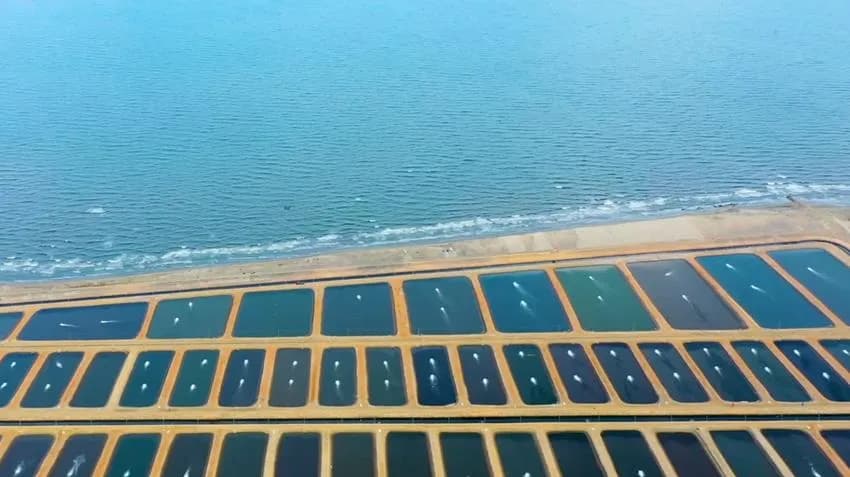
El-Deeba Triangle Fish Farming Project, west of Port Said
Location
The El-Deebah Triangle, west of Port Said, facing the sea, on the coast, approximately 14.2 km west of Port Said, and extending up to 600 meters from the shore.
Area
The first phase covers approximately 204 acres.
Farming Ponds
72 fish farming ponds dedicated to shrimp farming.
Planned annual production: Shrimp, approximately 250 tons per year.
Facilities: - 4 feed warehouses with a storage capacity of approximately 100 tons. Egyptian Presidency: - Sorting and packing hall with a production capacity of approximately 5 tons per day of fish and shrimp.
Project Phase
The first phase, comprising 107 acres and including 61 ponds (shrimp and marine fish), has been fully completed.
Cost
The total cost of the first phase is approximately EGP 300 million.
Some derived technical and functional figures:
The first phase includes 61 ponds: 41 marine fish ponds with a production capacity of 250 tons per year, and 20 shrimp ponds with a production capacity of 100 tons per year.
Therefore, the total expected production for the first phase is approximately 350 tons/year (marine fish + shrimp) on 107 acres.
A quick economic analysis
Information:
Fixed capital for the first phase: £300 million, for a production of approximately 350 tons per year.
This translates to approximately £857,000 per ton of fixed production (300 million ÷ 350 tons) in fixed costs alone—but this does not include operating costs (feed, labor, energy, maintenance), which can be substantial, especially for shrimp.
If we assume that operating costs add, for example, 40-60% of the total cost (depending on density, feed type, and efficiency), then the total cost per ton could be significantly higher.
However, the selling price of fish and shrimp also has a major impact: shrimp typically commands a much higher price than fish, especially if it is of high quality and destined for export or high-end markets.
Likewise, the presence of sorting and packing facilities and the project's proximity to a port or good means of transport contribute to reducing logistical costs.
Suggestions for improvement/things to consider in such a project:
Selecting shrimp and marine fish strains that perform well in the local marine environment and are disease-resistant.
Implementing a water quality monitoring and marine disease control system.
Ensuring a supply of good and safe feed.
Reduced waste (fish deaths, water leaks, pollution).
Efficient use of energy and pumps.
Avoidance from sources of pollution or adverse ocean currents.


