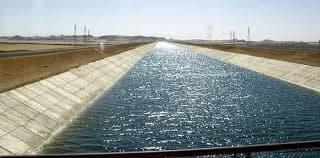
The Toshka project is one of the largest land reclamation projects in Egypt, and it holds great promise for achieving food security and agricultural development outside the Nile Valley. Despite the significant challenges, the potential is also immense. Success depends on financing
Location and Geographical Formation
The Toshka Lakes are naturally formed lakes, partly due to flooding caused by the Aswan High Dam. They are fed by Lake Nasser via the Toshka Canal or Spillway.
Toshka is located in the southwestern desert, in the Toshka Depression, south of Aswan, approximately 225 km south of Aswan.
The Toshka Agricultural Project “Toshka Al-Khair” and Land Uses The Toshka lakes are not just natural fishing lakes; the associated project is a large-scale agricultural/desert land reclamation project with the following objective:
The project, officially known as "Toshka El Kheir," is part of a broader initiative to reclaim and cultivate desert land in southern Egypt.
The goal is to reclaim and cultivate approximately 450,000 to 500,000 acres in Toshka and its surrounding areas.
Some of the sub-districts include: Al-Uwaynat, Toshka 3, Toshka 4, and others. For example, Toshka 4 has a farm area of approximately 140,000 feddans.
By the 2024/2025 agricultural year, the cultivated area in Toshka had reached approximately 500,000 feddans, with plans to increase it to about 560,000 feddans by 2025/2026.
Infrastructure and Water
The government constructed massive pumping stations to raise the water level, attempting to overcome the challenges associated with the elevation difference (~40 meters) in some parts of the project.
Two giant main pumping stations were built to supply the project with water, and these facilities handle large-scale daily pumping operations.
Irrigation networks and pivot irrigation systems are used in some areas.
Irrigation: The project relies on pumping water from Lake Nasser (part of the Aswan High Dam project) through canals, pipes, and pumps to the desert lands.
One source states: “More than 400 high-efficiency pumps (Wilo split-case pumps) can withstand temperatures up to 50°C and operate in desert conditions.”
Electricity infrastructure: For example, a 220 kV substation to serve the project and connect the electricity grid.
Agricultural and new community infrastructure: Construction of housing units, road networks, drainage systems, and water pumping stations. For example, in New Toshka City, 612 housing units, a medical center, a mosque, and a commercial market have been completed.
Challenges Facing the Toshka Lakes/Toshka Project From Studies and Local Sources:
Land and Geographical Features
The presence of granite rocks and natural barriers hinders the expansion of some branches. The land in some areas is not easily suitable for agriculture without soil treatment and proper fertilization and irrigation.
Water
The biggest challenge is securing a sufficient and consistent water supply, especially since the project partially relies on spillway water, which can be variable.
Balancing surface and groundwater use, along with the need for water conservation and the optimal use of modern irrigation technologies.
Funding and Infrastructure
The project experienced periods of delays or poor implementation due to funding shortages or logistical complexities.
Establishing the basic infrastructure (roads, pumping stations, electrical connections, irrigation infrastructure) is costly and requires significant time and effort.
Salinity and Soil Quality
In some areas, the soil is highly saline or has variable salinity, necessitating soil treatment or the selection of salt-tolerant crops.
Management control
Coordination between multiple entities: irrigation, agriculture, land reclamation, contracting, investment companies, and the environment. Large projects sometimes face administrative delays or slow implementation.
Current Status and Achieved Results
The project has been strongly revitalized in recent years, with clear political directives from the state to reclaim agricultural land in Toshka.
Hundreds of thousands of acres have been reclaimed and cultivated; for example, wheat has been planted on approximately 500,000 acres in Toshka within the project area.
Infrastructure has been developed: water lifting network, pumping stations, road networks, and some housing services.
Modern agricultural technologies are being used, such as center-pivot irrigation, powerful pumping stations, and efforts are underway to conserve water.
Fish farming potential in Toshka Lakes
Although the agricultural project is the main focus, Toshka Lakes can be used or developed as natural fisheries or aquaculture projects: The lakes provide large bodies of water — which can be used for local fishing or fish farming if good water conditions are available (stable water, suitable quality, fry, feed)With investment in fish farming, it's possible to separate agricultural water from fish water, or to utilize some lakes not currently used for agriculture for aquaculture.
Existing infrastructure—water, transportation, roads, and electricity—can be used to support a fish farming project alongside agriculture.
Summary and conclusions: The Toshka lakes are not a “lake” in a fixed sense like Lake Manzala or Lake Burullus, but rather a water depression fed by floods and spillways, with lakes formed from the accumulation of water, used within the Greater Agriculture Project.
The project has ambitious goals, some of which have been achieved, but a gap remains between the stated objectives (for example, reclaiming 450,000-500,000 acres) and what has been fully accomplished, due to the aforementioned challenges.
The potential exists, especially if modern irrigation technologies are used, the soil is treated, and fish stocks and aquaculture support are provided.
Background and Establishment The project began in the late 1990s, approximately 1996–1997, under the name Wadi Toshka or “New Valley/Toshka” as part of a plan to expand agricultural land outside the Nile Valley.
The goal was to transform vast areas of desert into cultivated agricultural land, thereby relieving pressure on the Nile Valley and Delta and contributing to food security.
Project location: Southern Egypt, approximately in the Aswan Governorate, in the Toshka region south of the Nile Valley—roughly bordering the Western Desert.
Main objectives of the project: Expanding arable land: The goal was to reclaim approximately 540,000 acres (about 2.27 million km² or more, according to sources) in the original project.
Achieving self-sufficiency in staple crops, such as wheat, which is considered a strategic commodity in Egypt. One news report stated that the Toshka project could produce approximately 500,000 tons of wheat.
Creating job opportunities and urban development: through the establishment of new residential and agricultural communities, and encouraging agriculture-related industries.
Using modern technology in irrigation and agriculture: such as centralized irrigation systems (sprinkler circular fields) and large pumping stations.
Project size and current status
The reclamation of more than 400,000 acres (approximately 1.68 million acres = 400,000) was announced up to mid-2024, with a target of reaching 600,000 acres by the end of 2025.
In another report: The project aims to reclaim an area of more than 2,200 km² (≈ 220,000 hectares) by 2024, with plans to expand to 4,200 km².
Wheat harvesting began on some lands within the project during the year 2022/2023.
Key achievements to date:
Modern irrigation technologies have been implemented in the project.
Agricultural housing projects, such as the new city of Toshka, have been launched.
Agriculture and agro-industry have been stimulated and linked to new cities and communities.
Strategic Dimensions – Why Is It Important?
Food Security: Egypt relies heavily on imports of wheat and agricultural products, and this project helps reduce external dependence.
Relieving population pressure: By expanding agricultural land and communities outside the Nile Valley, the project helps to redistribute the population.
Integrated development: The project encompasses not only agriculture but also infrastructure, land reclamation, city building, and agro-industrial production.
Contributing to Egypt's Vision 2030: As some sources have indicated, the project is part of Egypt's vision for sustainable development.
Critical view and observations
Some sources indicate that the first part of the project did not achieve all the ambitions, and that it faced technical or financial problems.
Some desert environments make costs higher than expected, and returns may be delayed.
The need for water resources is significant, especially in the context of Egypt, which suffers from water stress; therefore, ensuring the sustainability of water use is crucial.
Agriculture must be linked to sustainable water, soil, and maintenance management; otherwise, the impact may be less than anticipated.
Future Vision and Opportunities
Expansion in the next phases: such as reclaiming additional land and building agricultural and industrial communities.
Agricultural Exports: Since the surplus can be exported, this strengthens the national economy.
Using smart technologies in agriculture and irrigation—such as artificial intelligence, automated water pumping, and centralized irrigation systems.
Enhancing coordination between agriculture, industry, transportation, and housing—to create an integrated agro-industrial community, not just agriculture.
The opportunity to transform desert areas into development hubs — provided there is good management.